Users of this
eyeshadow and false eyelashes can fly a drone by blinking.
(This is a translation of an original article published in the Daily Mail on 24/10/2013: http://www.dailymail.co.uk/sciencetech/article-2474788/The-drones-controlled-MAKE-UP-Conductive-eyeshadow-false-eyelashes-let-wearers-drive-aircraft-blinking.html#ixzz2ieGT8Pyn )
The Beauty Technology project adds sensors to eyeshadow and false eyelashes for the first time. Using conductive ink as eyeliner, applied to the top and bottom of the eye, it makes it so that when a user blinks for more than half a second, the sensors come into contact with the ink. This creates a low-voltage circuit that powers the remote drone's motor. False nails can also be equipped with tags that can automatically open doors, among other things.
Forget Google Glass or Samsung's latest smartwatch, the next trend in wearable technology is makeup.
A Brazilian scientist has combined conductive materials and wireless tags with beauty items like eyeshadow, eyeliner, false eyelashes, pictured, and nails. Wearers can blink, wink, or press their nails on certain surfaces to control different devices.
Brazilian scientist Katia Vega demonstrated this earlier this month at the Interactive Tables conference at the University of St Andrews.
As she explained: “Beauty technology consists of wearable devices that function as electronics, removable and hidden, attached to the body’s surface.”
“Common beauty products are easy to put on and take off, are ergonomically designed for the human body, are widely available, and their primary purpose is to enhance physical appearance.”
For the Blinklifier system, Vega added tiny sensors to powdered eyeshadow. She then created false eyelashes coated in a metal solution attached to stickers coated with conductive ink.
When a user blinks or winks for more than half a second, the sensors connect with the metallized eyelashes and conductive ink to complete a low-voltage circuit.
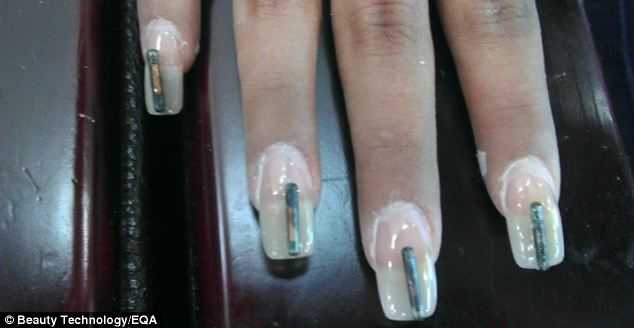
Pictured are false nails equipped with radio-frequency identification (RFID), small magnets, or conductive polish. When integrated with tags, the nails can be held near RFID readers to perform a series of tasks, such as opening doors, for example, or using the tags instead of bus or performance tickets.
Once connected, this circuit drives a small actuator or motor. When the eye opens and the connection breaks, the motor turns off.

Vega said: “We faced the issue of whether the ink we were using was a safe material to use on the body, as it was not specifically approved for use on skin, much less as eyeliner, since this product is water-soluble. With the moisture from the eyes and skin, it could cause problems for the user. This is why we created stickers that look like makeup, which are conductive and easy to remove from the skin.”
The possibilities are enormous; for example, small magnets can be installed in nails to activate magnetic switches in smart devices, including proximity sensors in phones. According to the project's website: “Imagine not needing a card to open the door, or to pay for your bus ticket. Imagine not needing to carry any ticket to go to the cinema. Go and shop at the supermarket or borrow a book from the library without a card or ID, just point and pay for it, all at your fingertips: your nails.”
One project, called 'AquaDJing', involves a DJ using Beauty Nails technology to mix songs by touching the surface of water, for example. If we connected them to a piano, which in turn is connected to software, we could make it recognize the note we are playing through the nails.
(Read the original article in the Daily Mail: http://www.dailymail.co.uk/sciencetech/article-2474788/The-drones-controlled-MAKE-UP-Conductive-eyeshadow-false-eyelashes-let-wearers-drive-aircraft-blinking.html#ixzz2ieGT8Pyn )

